Ideas & legends · 3 MIN
Who is dreaming whom?
谁在梦见谁?
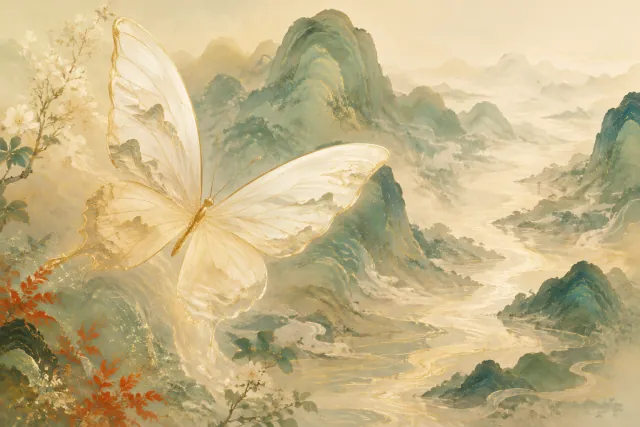
In the closing passage of the second chapter of the Zhuangzi, Zhuang Zhou dreams that he is a butterfly. There is no need, within the dream, to explain the change. He is simply there, fluttering, at ease. For that moment, he does not know himself as Zhou.
《庄子·齐物论》的结尾讲了一个故事:庄周梦见自己变成了一只蝴蝶。在梦里,他自由地飞着,十分自在,忘记了自己是庄周。
Then he wakes. He is Zhou again. The story could stop here, with waking life comfortably restored. Instead, it turns back on itself: was Zhou dreaming of being a butterfly, or is a butterfly dreaming of being Zhou?
后来,他醒了,又是庄周了。故事没有就这样结束:究竟是庄周梦见自己是蝴蝶,还是蝴蝶梦见自己是庄周呢?
The question is not presented as a trick with an answer on the next page. It makes the familiar position of the reader less comfortable. A moment ago, we watched a person have a dream. Now we have to ask what made that viewpoint feel so certain.
这个问题不是一道马上就能找到标准答案的谜语。刚才,我们以为自己只是在听一个人做梦的故事。现在,我们也要想一想:为什么自己刚才那么肯定?
The passage still distinguishes Zhou from the butterfly. Its final phrase names 物化, often rendered as the transformation of things. That closing phrase matters: this is not simply a slogan saying that nothing is real, or that all differences disappear.
原文仍然说庄周和蝴蝶之间有区别,并用“物化”结束这一段。“物化”可以理解为事物的变化。我们不必把故事简单地读成“一切都不真实”,也不必认为所有区别都消失了。
One useful reading is an invitation to notice perspective. The dream feels complete while it lasts; waking brings another frame. The story can make us slower to treat our present view as the only possible one. This is an interpretation for discussion, not a claim that the text offers a modern scientific theory of dreaming.
一种读法是:这个故事邀请我们留意看事情的角度。做梦时,梦里的世界似乎很完整;醒来后,我们又有了另一种看法。这可以提醒我们,不要急着把自己的看法当成唯一的答案。这是供讨论的解释,不是现代的梦境科学理论。
Chinese gives the question a useful shape: 是……还是……? Use it when offering alternatives: 是梦,还是现实? “Is it a dream, or reality?” Saying the pattern is a language exercise; agreeing with a philosophical interpretation is not required.
“是……还是……?”可以用来询问两种可能。例如:“是梦,还是现实?”练习这个句式,只是在练习表达选择;你不必先同意某一种哲学解释。
Keep the butterfly as a question rather than a conclusion. The next time two people describe the same moment differently, ask what each could see from where they stood. The story has not solved the disagreement. It has given you another way to enter it.
可以把蝴蝶留作一个问题,而不是一个结论。下次听见两个人对同一件事有不同的描述时,不妨想想:从各自的位置,他们看到了什么?故事没有替我们解决分歧,却给了我们另一种思考方式。
Sources & reading notes
An original modern Chinese and English retelling of the closing passage of Zhuangzi, chapter 2. It is a philosophical story, not a report of a verified event. Interpretations are labelled as readings.
- Zhuangzi · Inner Chapters · Qi Wu Lun, closing passage
Base passage begins 昔者庄周梦为胡蝶 and ends 此之谓物化. New retelling, not a reproduction of the displayed English translation.
The iPhone app adds private saving, contextual vocabulary and optional practice. No video or account is required to read.